Your Cart is Empty

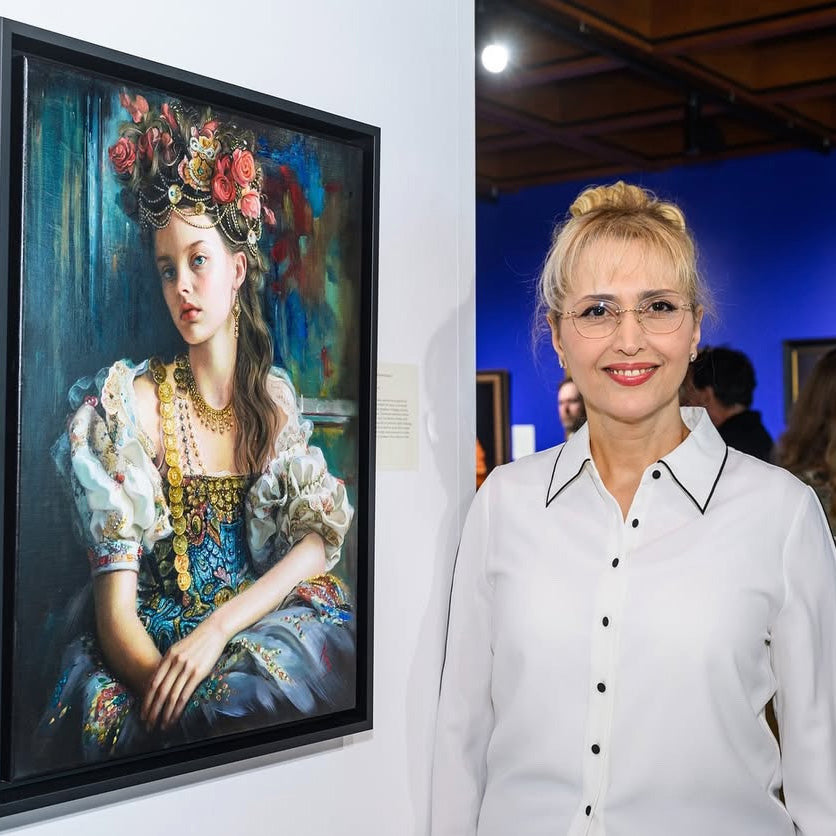

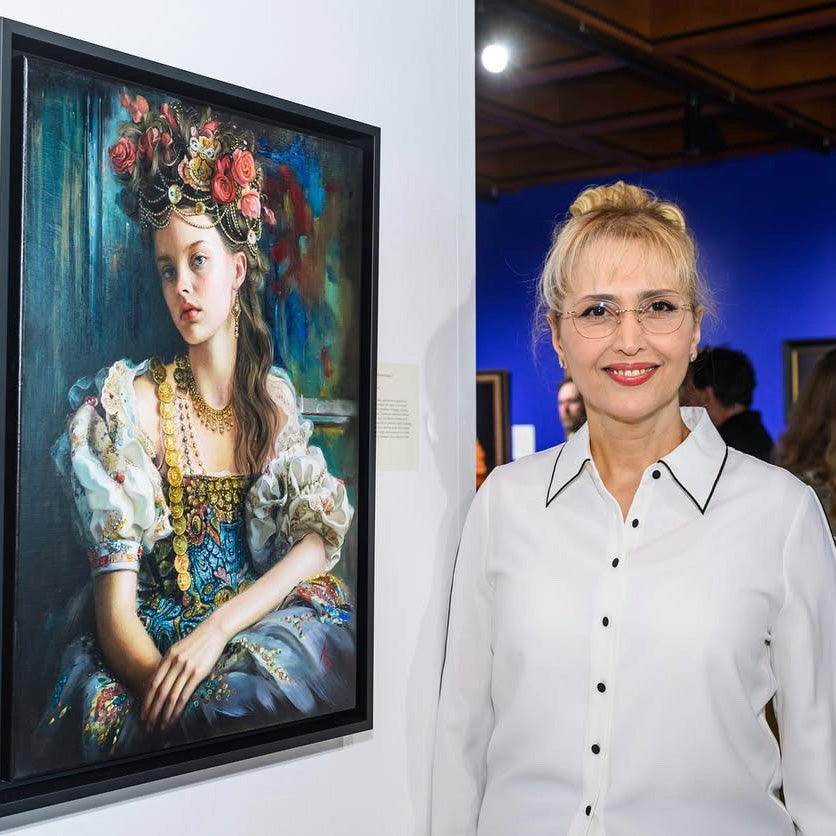
In her current body of work, Alexandra Manukyan continues to blur the line between the tangible and the transcendent, weaving narratives of burden, beauty, and transformation through the feminine form. Her paintings, rich with symbolism, theatricality, and emotional depth, invite us into worlds where fragility becomes strength and where identity is both performed and revealed.
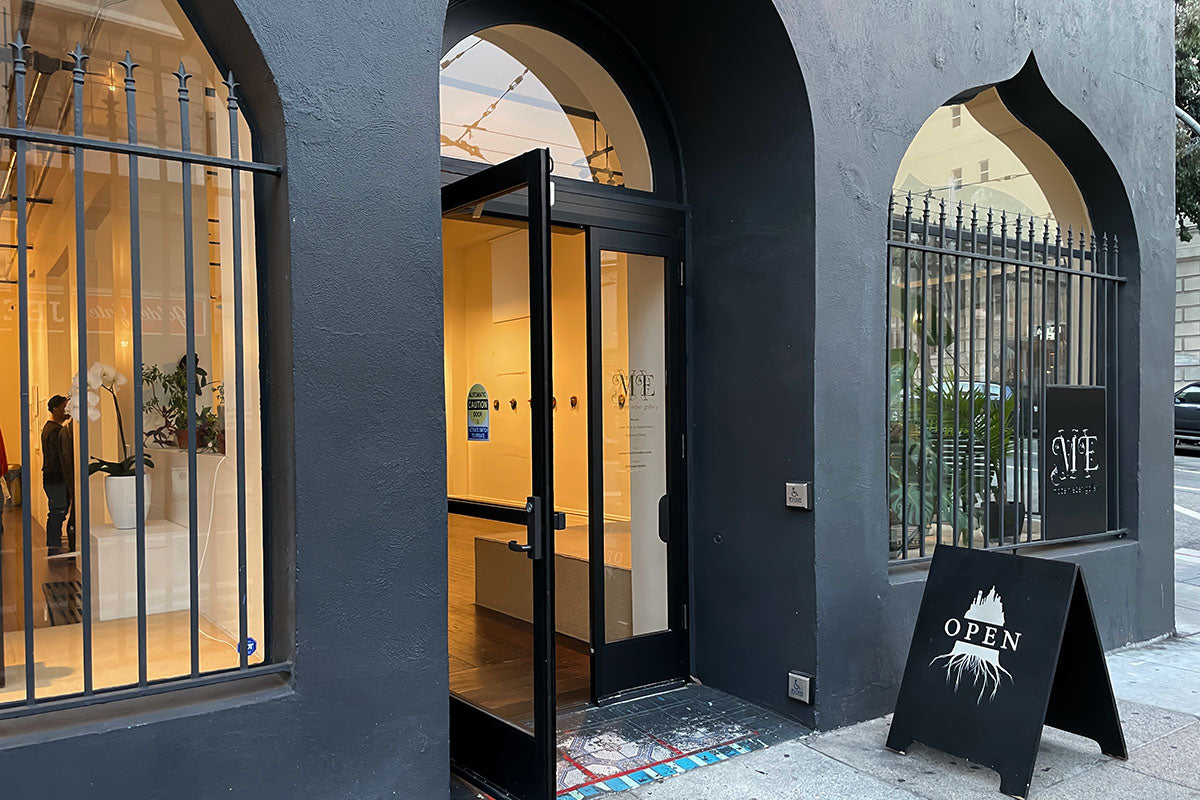
In this exclusive interview with Modern Eden Gallery, Alexandra reflects on the dualities that define her practice: the weight of human grief carried through the female body, the interplay between concealment and truth, and the evolving tension between timeless tradition and our rapidly shifting digital age. What emerges is a portrait of an artist who paints not just figures, but the human condition itself—layered, vulnerable, and endlessly resilient.

ME: Your paintings often feature the feminine form carrying the weight of human grief and mistakes. What draws you to explore resilience and burden through the female body specifically?
AM: I see the female body as both fragile and indestructible, a vessel that carries the deepest sorrows of humanity yet also the power to transform them into something transcendent. Women, throughout history, have borne grief and responsibility not only for themselves but for entire communities and generations.
By placing that weight on the feminine form, I create a universal metaphor for resilience. She bends, but does not break. For me, the female body becomes an archetype of endurance, embodying the eternal struggle between suffering and transcendence.

ME: You’ve spoken about masks and assumed identities obscuring our shared humanity. How do you decide which symbols or visual motifs best capture these hidden facades in your work?
AM: The symbols in my work often arise from observing how we conceal vulnerability behind roles and facades. I choose masks, armor, threads, or theatrical elements because they carry layered meanings across cultures as protection, disguise, or performance.
These motifs embody both concealment and revelation. A mask may obscure identity, but in the act of painting it becomes a revelation, exposing what is lost when we distance ourselves from authenticity.

ME: Many of your works seem to weave together tradition and innovation—oil painting techniques alongside surrealist, almost futuristic elements. How do you balance those two worlds in your creative process?
AM: For me, tradition and innovation are not opposites but companions. My training in old master techniques gives me discipline, depth, and permanence and a foundation I deeply respect. At the same time, my imagination belongs to the contemporary world, filled with surreal, dreamlike, and futuristic imagery.
I balance the two by integrating them. The old masters give me structure, while the imaginative elements allow me to push boundaries. Together, they form a language that feels both timeless and alive.

ME: With your background in fashion and entertainment, do you feel that designing wearable art and working in those industries shaped the theatrical or ornamental qualities present in your paintings?
AM: Absolutely. My experience in fashion and costume design taught me how surface and ornament can shape identity. A garment can be a mask, a shield, or an extension of power. These are ideas that naturally flow into my paintings. The theatricality and ornamentation in my work come from this background, but they are never decorative for their own sake.
They function as visual metaphors, amplifying the psychological or spiritual states of my figures. Fashion gave me the language of spectacle; painting allows me to reveal the emotional truths hidden beneath the costume.

ME: The figures in your paintings exist in deeply imaginative, almost mythic environments. Do you see your work as storytelling? What kinds of stories do you most want to tell?
AM: Yes, my paintings are storytelling, though not in a literal sense. Each work is a fragment of a larger myth, a symbolic narrative about burden, resilience, and transformation. The environments I create are liminal spaces that are not confined by time or geography, but existing where the inner and outer worlds merge.
The stories I tell are universal: about the masks we wear, the grief we carry, and the hope that persists. They are not just mine, but reflections of our shared humanity, inviting viewers to find their own journeys mirrored within them.

ME: Your art examines how technology impacts both the body and the psyche. How has your perspective on this theme evolved as technology has become even more entwined with our daily lives in recent years?
AM: When I first explored technology in my work, I saw it as a double edged force, both promising progress and fostering alienation. Over time, as it has become inseparable from our daily lives, I’ve realized how profoundly it reshapes our inner worlds. It alters how we perceive identity, intimacy, and even solitude.
In my paintings, I explore how the body becomes fragmented under digital culture, and how the psyche is both empowered and burdened by constant exposure and surveillance. My work now feels more urgent, questioning whether technology reveals or obscures our humanity in this new age.
Comments will be approved before showing up.
Loading extension...